
Artemis II Returns Safely After Historic Moon Mission
NASA’s Artemis II mission has successfully returned to Earth after completing the first crewed lunar flight in more than five decades, ending with a controlled splashdown in the Pacific Ocean following a high-speed re-entry. According to Britain Chronicle analysis, the mission represents a pivotal moment in modern space exploration, not only for its technical success
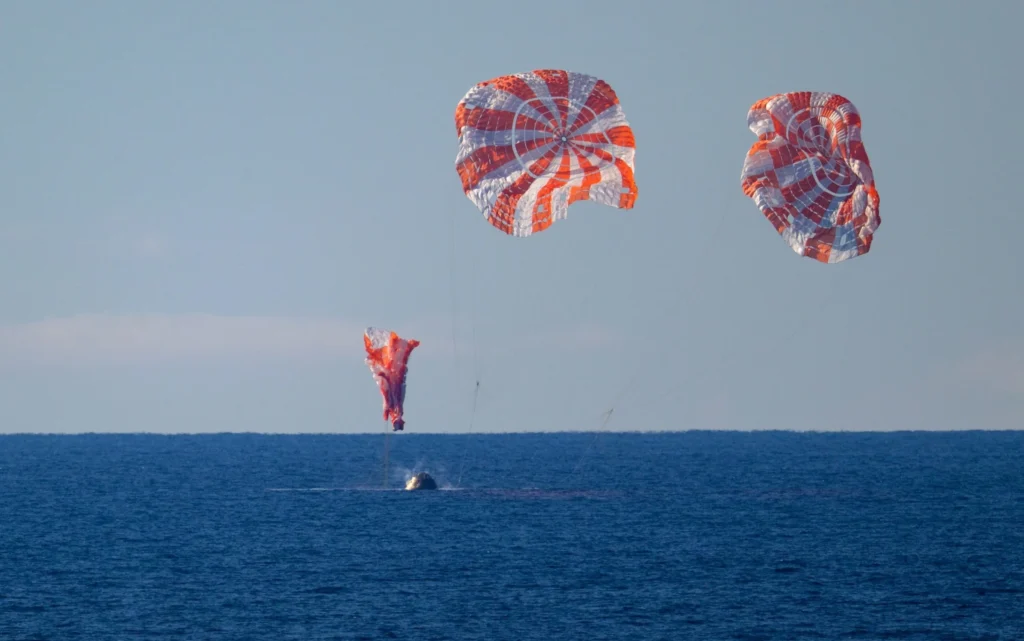
NASA’s Artemis II mission has successfully returned to Earth after completing the first crewed lunar flight in more than five decades, ending with a controlled splashdown in the Pacific Ocean following a high-speed re-entry.
According to Britain Chronicle analysis, the mission represents a pivotal moment in modern space exploration, not only for its technical success but also for its role in re-establishing sustained human presence beyond low Earth orbit.
The return of the four-person crew marks a renewed era of lunar ambition for NASA, as global attention now shifts toward long-term Moon missions and future preparations for Mars exploration.
What Happened?
The Artemis II spacecraft, Orion, re-entered Earth’s atmosphere at extreme velocity before deploying a sequence of parachutes that slowed the capsule for a safe landing in the Pacific Ocean near the US west coast.
The four astronauts onboard—Reid Wiseman, Victor Glover, Christina Koch, and Jeremy Hansen—completed a mission lasting just over nine days, during which they travelled nearly 700,000 miles and reached a record distance of more than 250,000 miles from Earth.
The mission concluded with a precise splashdown shortly after 1am UK time, followed by a coordinated recovery operation involving naval teams, helicopters, and inflatable vessels. Despite intense heat and a brief communication blackout during re-entry, the spacecraft performed as expected.
NASA confirmed that the re-entry trajectory had been adjusted following lessons from the uncrewed Artemis I mission, which had experienced heat shield issues. This time, the steeper descent appeared to prevent similar complications.
Once the capsule stabilised in the ocean, recovery crews secured the spacecraft before transferring the astronauts to a nearby naval vessel. All four crew members were reported to be in good condition.
Why This Matters
The success of Artemis II marks the first time since the Apollo era that humans have travelled to the Moon and returned safely, signalling a major step toward sustained lunar exploration.
Beyond its symbolic importance, the mission provides critical technical validation for NASA’s Orion spacecraft, re-entry systems, and deep-space communication protocols. These systems will be essential for future missions involving lunar landings and extended surface operations.
The mission also carries geopolitical and scientific weight, as multiple space agencies and private companies are competing to establish a long-term presence on the Moon. Success here strengthens NASA’s position in shaping the next phase of space exploration.
In practical terms, the data gathered during Artemis II will directly influence Artemis III, which aims to return astronauts to the lunar surface later this decade.
What Analysts or Officials Are Saying
NASA officials described the mission as a major milestone in rebuilding human deep-space capability. Senior administrators emphasised that Artemis II demonstrated both operational reliability and the feasibility of extended crewed missions beyond Earth orbit.
Space policy analysts highlighted the significance of real-time public engagement during the mission, noting that live-streamed coverage allowed global audiences to follow the journey in unprecedented detail compared to the Apollo era.
International space representatives, including the Canadian Space Agency, praised the mission as a symbol of global cooperation in space exploration, reflecting the multinational nature of modern lunar programmes.
Experts also pointed out that while the mission was technically successful, the upcoming Artemis missions will face greater challenges, particularly in lunar landing systems and long-term habitat planning.
Britain Chronicle Analysis
Artemis II is more than a successful spaceflight; it is a strategic reset in humanity’s relationship with deep space exploration. After decades of orbital-focused missions, NASA is clearly signalling a return to ambitious, crewed lunar operations.
What stands out most is the combination of technical precision and public transparency. Unlike Apollo-era missions, Artemis II unfolded in real time for global audiences, turning a highly complex scientific operation into a shared human experience.
This transparency also raises expectations. Future missions will not only be judged on engineering success but also on their ability to sustain public interest and justify the significant financial investment required for deep-space programmes.
There is also a competitive dimension emerging. With private aerospace firms and other national space agencies advancing rapidly, NASA’s success with Artemis II strengthens its leadership position but does not guarantee long-term dominance.
What Happens Next?
NASA will now begin a detailed technical review of the Orion spacecraft, focusing on heat shield performance, re-entry data, and life-support systems to confirm readiness for future missions.
The next major milestone is Artemis III, currently planned for the coming years, which aims to land astronauts on the Moon’s surface using commercial lunar landers developed by private partners.
In parallel, NASA is expected to refine long-duration mission protocols, including surface operations, habitat systems, and crew rotation strategies designed to support a sustained lunar presence.
The Artemis programme is now moving from demonstration to expansion, with the next phase likely to define the long-term future of human activity beyond Earth orbit.
Meta AI Muse Spark Rolls Out: Is It Getting Too Smart?

Australia social media ban goes global amid doubts

EU Accused of Hiding Data Centre Emissions After Lobbying
EU Launches Age Verification App to Protect Children Online

France Invests €500m in Quantum Computing Race Push

Beyond rebrand signals a shift in Google Cloud strategy