
France Invests €500m in Quantum Computing Race Push
France has launched a €500 million national push into quantum computing, backing a cluster of startups working on competing hardware approaches in a bid to position Europe as a global leader in the emerging technology. According to Britain Chronicle analysis, the investment marks one of the most ambitious European state-led bets on frontier computing, targeting
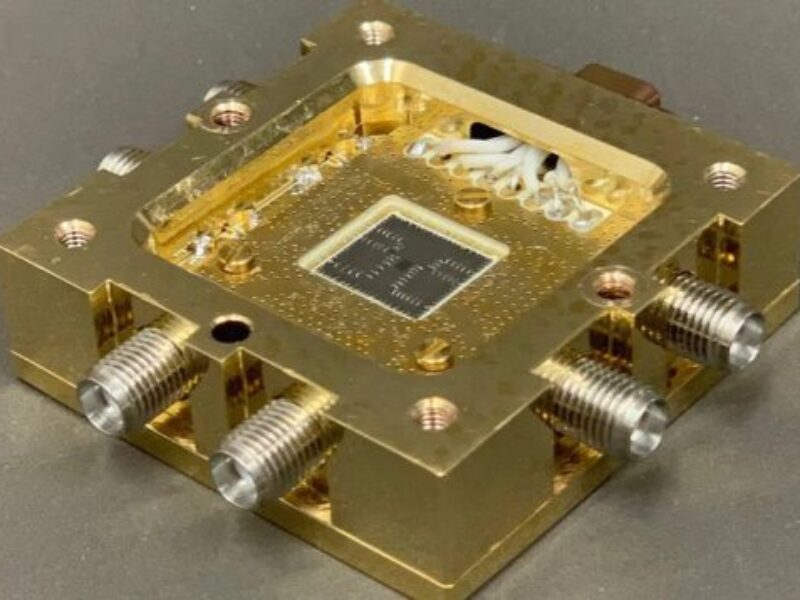
France has launched a €500 million national push into quantum computing, backing a cluster of startups working on competing hardware approaches in a bid to position Europe as a global leader in the emerging technology.
According to Britain Chronicle analysis, the investment marks one of the most ambitious European state-led bets on frontier computing, targeting a sector where the region has historically lagged behind the United States and China in commercialisation.
The initiative comes as quantum computing moves from theoretical research toward early-stage industrial development, with governments increasingly viewing it as a strategic technology with long-term economic and security implications.
What Happened?
The French government has committed €500 million to accelerate quantum computing development through the PROQCIMA programme, a structured national effort designed to deliver a fault-tolerant quantum computer within the next decade.
Five companies have been selected for the first phase: Alice & Bob, Pasqal, Quandela, Quobly, and C12 Quantum Electronics. Each is pursuing a different qubit architecture, ranging from cat qubits and neutral atoms to photonics and silicon-based systems.
The programme is designed as a competitive funnel. After four years, only the most promising technologies will advance, with further reductions planned in later stages until a small number of leading approaches remain.
Among the most closely watched firms is Paris-based Alice & Bob, which is developing so-called “cat qubits” designed to reduce error rates at the hardware level, potentially lowering the need for large-scale error correction systems.
Other participants are also making progress. Pasqal is deploying neutral-atom systems in high-performance computing environments, while Quobly has already integrated its silicon wafers into industrial semiconductor production lines. Quandela is preparing cloud-based access to photonic quantum processors through European infrastructure partnerships.
Why This Matters
Quantum computing is widely viewed as one of the most strategically important technologies of the next decade, with potential applications in drug discovery, materials science, logistics optimisation, and cryptography.
Europe has repeatedly struggled to translate scientific leadership into commercial dominance in previous technological waves, including cloud computing, mobile platforms, and artificial intelligence. France’s investment signals an attempt to change that pattern.
The diversification strategy is particularly significant. Rather than betting on a single technical approach, France is funding multiple competing architectures in parallel, increasing the likelihood that at least one will scale successfully.
This approach also reflects the uncertainty of the field itself, where no dominant design has yet emerged and engineering challenges remain substantial.
What Analysts or Officials Are Saying
Industry experts note that France’s quantum companies benefit from strong academic foundations and relatively lower energy and infrastructure costs compared with some US counterparts.
Quantum entrepreneur Théau Peronnin of Alice & Bob has argued that the field is defined less by speed and more by the ability to reduce errors to unlock practical computation, suggesting architectural innovation may matter more than raw qubit counts.
Researchers also highlight France’s deep physics talent pipeline, citing contributions from leading institutions that have produced Nobel Prize-winning work in quantum optics, entanglement, and spintronics.
At the same time, analysts caution that current systems remain far from commercial utility, with existing quantum machines still operating at experimental levels of performance.
Britain Chronicle Analysis
France’s quantum strategy represents a calculated attempt to gain early control of a technology where market leadership has not yet been locked in.
Unlike previous digital revolutions, quantum computing does not yet have entrenched global winners, giving late entrants a more realistic chance of competing at the highest level if they can sustain long-term funding and industrial coordination.
However, the gap between scientific promise and practical application remains wide. Many of the most advanced systems today still function primarily as research platforms rather than commercially viable tools.
The success of this €500 million strategy will therefore depend not only on technical breakthroughs, but also on France’s ability to maintain political commitment through a long development cycle that could stretch well beyond a decade.
For Europe, the stakes are broader than national leadership. Quantum computing is increasingly seen as a test of whether the continent can convert its research excellence into sustained technological sovereignty.
What Happens Next
The PROQCIMA programme will continue to evaluate competing quantum architectures over the coming years, with early eliminations expected after the first development phase.
Companies will now scale laboratory prototypes into more advanced systems, with milestones set for both intermediate and long-term performance targets extending into the 2030s.
Further private investment is likely to follow if early technical benchmarks are met, particularly in companies showing progress toward scalable fault-tolerant systems.
The broader outcome will determine whether Europe can establish a credible position in quantum computing or once again fall behind in the commercialisation of a breakthrough technology.
Meta AI Muse Spark Rolls Out: Is It Getting Too Smart?

Australia social media ban goes global amid doubts

EU Accused of Hiding Data Centre Emissions After Lobbying

EU Launches Age Verification App to Protect Children Online

Beyond rebrand signals a shift in Google Cloud strategy
AI Journalling App Turns Diary Writing Into Digital Bond