
Hungary’s Orbán Era Ends as Magyar Seizes Power Shift
Péter Magyar’s Tisza party has delivered a decisive electoral victory in Hungary, bringing an abrupt end to Viktor Orbán’s 16-year rule. The opposition secured 52% of the vote and 140 seats in the 199-seat National Assembly, while Fidesz dropped sharply to 53 seats. According to Britain Chronicle analysis, this result marks one of the most
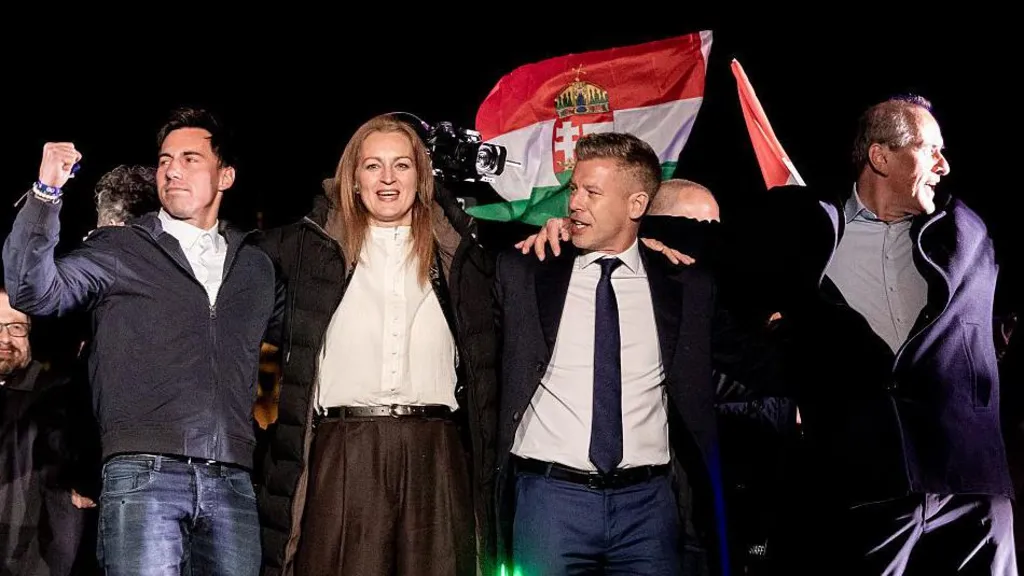
Péter Magyar’s Tisza party has delivered a decisive electoral victory in Hungary, bringing an abrupt end to Viktor Orbán’s 16-year rule. The opposition secured 52% of the vote and 140 seats in the 199-seat National Assembly, while Fidesz dropped sharply to 53 seats.
According to Britain Chronicle analysis, this result marks one of the most significant political reversals in modern Hungarian history, reshaping not only leadership but also the structure of state power built over more than a decade and a half.
The transition is already moving at pace. Parliament is expected to convene in early May, with Magyar pushing to install a new government quickly, even as questions grow over institutional stability, accountability, and the future direction of the country.
WHAT HAPPENED?
Hungary’s parliamentary election produced a clear and unexpected landslide. Péter Magyar’s Tisza party surged ahead of Viktor Orbán’s Fidesz, ending years of political dominance in a single vote.
The final seat distribution reflects a dramatic collapse in support for the governing party. Fidesz, which once controlled a strong parliamentary majority, now holds just 53 seats compared to its previous 135. The shift signals a deep realignment in voter sentiment across the country.
President Tamás Sulyok has agreed to accelerate the formation of the new parliament, setting the stage for a rapid transfer of power. The process is expected to begin in the week of 4 May, allowing the incoming leadership to begin legislative work without prolonged delay.
Orbán has since broken his silence, acknowledging defeat and describing the moment as the end of an era. While he accepted responsibility, he avoided detailed reflection on policy missteps, instead pointing briefly to delays in major infrastructure projects such as the Paks 2 nuclear plant.
WHY THIS MATTERS
The outcome fundamentally reshapes Hungary’s political system. After 16 years of concentrated leadership under Orbán, the country is now entering a period of rapid institutional change under a government that holds a two-thirds parliamentary majority.
That majority gives the incoming administration unusual legislative power. It could enable constitutional reforms, including proposals to limit prime ministers to two terms, a move that would directly block any potential political comeback by Orbán.
The result also carries major economic and diplomatic consequences. Hungary remains partially restricted from accessing €17 billion in EU funds due to concerns over governance, judicial independence, and media freedom. Restoring that funding will depend on meeting strict European Union conditions.
Beyond economics, the shift may also redefine Hungary’s position within Europe. The new leadership has signalled closer alignment with EU institutions, raising expectations of a recalibration in foreign policy direction.
WHAT ANALYSTS OR OFFICIALS ARE SAYING
Within Fidesz, reactions have ranged from calls for continuity to demands for internal renewal. Some senior figures argue Orbán should remain in place during a transition phase, while others are pushing for a formal leadership contest later this year.
Party insiders acknowledge that there is no obvious successor with Orbán’s political influence or organisational control. While senior ministers such as Péter Szijjártó and János Lázár have been visible in recent years, neither is seen as a unifying figure capable of rebuilding the party alone.
On the opposition side, Péter Magyar has taken a far more confrontational stance. He has promised accountability measures targeting alleged corruption within the previous government and has signalled that political consequences will follow quickly after the transfer of power.
Public reaction has also been sharply visible in Budapest, where political posters associated with the former government have been vandalised or defaced, reflecting a sudden and emotional shift in the political climate.
BRITAIN CHRONICLE ANALYSIS
This transition is not simply a change of leadership but a structural reset of Hungary’s political architecture. Orbán’s long tenure created a centralised system of governance that influenced institutions, media frameworks, and political decision-making across the state.
Dismantling that system will require more than electoral victory. It will demand sustained administrative reform, legal restructuring, and careful management of institutions that have operated under long-term political consolidation.
Magyar’s urgency reflects both opportunity and risk. The new government’s strong mandate allows for rapid reform, but the speed of change could also strain state institutions if not carefully managed. The balance between accountability and stability will define the early phase of his leadership.
There is also a broader European dimension. Hungary is now positioned as a test case for democratic transition after long-term single-party dominance. The EU will be watching closely to see whether institutional independence and governance reforms are implemented effectively.
WHAT HAPPENS NEXT
The immediate priority is the formal establishment of the new parliament and the election of Hungary’s next government. This process will set the tone for the political transition and determine how quickly reforms begin.
Attention will then shift to legislative changes, including proposals on term limits, anti-corruption frameworks, and institutional oversight. These measures are expected to form the core of the new administration’s early agenda.
Economic stability remains another urgent challenge. The government must address investor confidence, energy security concerns, and stalled development projects while managing expectations of rapid reform.
Finally, negotiations with the European Union will be crucial. Unlocking frozen EU funds will depend on demonstrating measurable progress in governance, transparency, and judicial independence.
Hungary is now entering a decisive phase in its political evolution, where the speed and direction of reform will determine whether this transition becomes a stable reset or the beginning of a more turbulent period of national restructuring.
UK Nuclear Deterrent: Vital for Britain’s National Defence

Ministers Urged to Share Mandelson Vetting Files Amid Disclosure Row

UK Considers Under-16 AI Chatbot Ban Amid Safety Push

MP Calls for National Biosecurity Strategy UK at Core of Security

Connor Naismith: Why Blue Labour is True Labour
NHS Legal Anomaly Costs Billions: Calls for Urgent Reform