Lagarde Says Eurozone Economy Falls Below ECB Outlook
The eurozone economy has weakened beyond the European Central Bank’s baseline expectations, according to ECB President Christine Lagarde, who says conditions now sit between baseline and adverse scenarios. Her comments come as policymakers assess the impact of rising geopolitical tensions and energy market disruption. According to Britain Chronicle analysis, Lagarde’s remarks reflect growing concern within
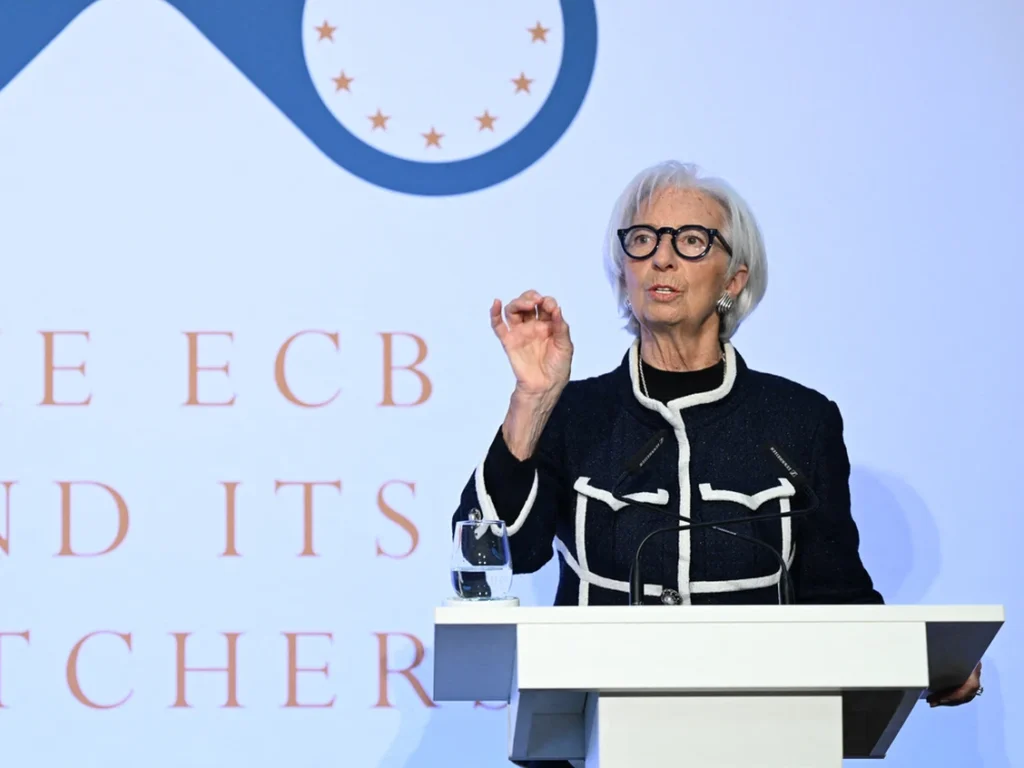
The eurozone economy has weakened beyond the European Central Bank’s baseline expectations, according to ECB President Christine Lagarde, who says conditions now sit between baseline and adverse scenarios. Her comments come as policymakers assess the impact of rising geopolitical tensions and energy market disruption.
According to Britain Chronicle analysis, Lagarde’s remarks reflect growing concern within the ECB that inflation pressures and external shocks are becoming harder to separate from underlying economic weakness, complicating the path for future interest rate decisions.
The statement was delivered during the IMF spring meetings in Washington, where global financial leaders are weighing the economic fallout from renewed instability in the Middle East and its potential impact on energy supplies and growth forecasts.
What Happened?
Christine Lagarde said the eurozone economy has drifted away from the European Central Bank’s central forecast, placing current conditions between the bank’s baseline and more pessimistic scenarios.
Speaking to Bloomberg Television, she noted that while the situation is weaker than expected, it does not yet justify a shift toward interest rate increases. The ECB, she said, remains guided by its objective of price stability while also monitoring financial stability risks.
The central bank is reassessing its outlook following several weeks of geopolitical tension in the Middle East, which has contributed to higher energy costs and weaker business confidence across Europe.
Inflation in the euro area remains above the ECB’s 2% target, with policymakers now debating how persistent recent price increases could become. Financial markets are currently pricing in the possibility of further rate hikes later in the year, though expectations for the next policy meeting remain uncertain.
New IMF projections also suggest global inflation could rise while growth slows, adding further complexity to the ECB’s decision-making process.
Why This Matters
The ECB’s shifting assessment signals that Europe’s recovery path is becoming more fragile at a time when inflation is still elevated and external risks are increasing.
Energy markets remain a key vulnerability, particularly as disruptions linked to geopolitical tensions continue to affect supply chains and pricing stability. This has a direct impact on consumer prices and industrial costs across the eurozone.
At the same time, weaker-than-expected growth suggests that tighter monetary policy could risk further slowing economic activity. This creates a difficult balancing act for policymakers trying to contain inflation without triggering a downturn.
The divergence between market expectations and central bank caution also highlights uncertainty about the direction of interest rates in the coming months.
What Analysts or Officials Are Saying
Lagarde stressed that the ECB is not currently biased toward tightening policy, describing its approach as guided by a “compass” focused on price stability supported by financial stability conditions.
Several ECB officials reportedly believe that the baseline economic scenario is becoming less likely as geopolitical tensions persist and energy supply risks grow, particularly around key shipping routes.
Market participants, however, continue to anticipate further rate hikes, with pricing suggesting more than two additional quarter-point increases this year, even as expectations for the upcoming policy meeting remain more cautious.
The IMF’s latest outlook adds further pressure, projecting higher global inflation alongside weaker growth, reinforcing concerns about stagflation-like conditions in parts of the global economy.
Britain Chronicle Analysis
Lagarde’s remarks underline a critical shift in tone from the ECB, moving from confidence in a controlled disinflation path to a more uncertain, scenario-driven outlook.
The key challenge for the central bank is that inflation risks are increasingly supply-driven, particularly through energy channels, rather than purely demand-led. This limits the effectiveness of traditional interest rate tools.
At the same time, Europe’s growth outlook is weakening, narrowing the ECB’s room to manoeuvre. Any aggressive tightening risks deepening economic fragility, while hesitation risks allowing inflation to remain above target for longer.
The reference to “between baseline and adverse” scenarios effectively signals that policymakers are no longer operating in a stable macroeconomic environment, but in a spectrum of escalating risks.
For markets, this increases volatility expectations, as rate paths become more dependent on geopolitical developments than purely domestic economic data.
What Happens Next
The ECB is expected to closely monitor energy prices and geopolitical developments ahead of its next policy meeting on April 29–30.
If inflation pressures persist or worsen, particularly through energy supply disruptions, further rate hikes could return to the table despite weaker growth signals.
However, if economic slowdown accelerates, pressure may build within the Governing Council to pause tightening and reassess the broader policy stance.
The coming months are likely to determine whether the eurozone stabilises near the ECB’s baseline forecast or moves closer to the more severe downside scenarios outlined in recent assessments.
Sustainable Empathy Leadership: Preventing Manager Burnout

Global Business Districts Rebound as Economic Hubs: EY Report

AI Floods Creative Market: The Need for Industry Governance
IMF warns Europe on targeted war energy support
Ireland’s Data Center Boom Strains Power and Growth Model

Iran Crisis Pushes EU Economy Off Summit Agenda