
Pressure Builds to Expel Eric Swalwell from Congress row
Pressure is intensifying inside the US Congress as lawmakers from both parties openly discuss whether Democratic Representative Eric Swalwell should be forced out of office. The push follows serious public allegations involving inappropriate conduct and sexual assault claims, which Swalwell has strongly denied. According to Britain Chronicle analysis, the unfolding debate is no longer just
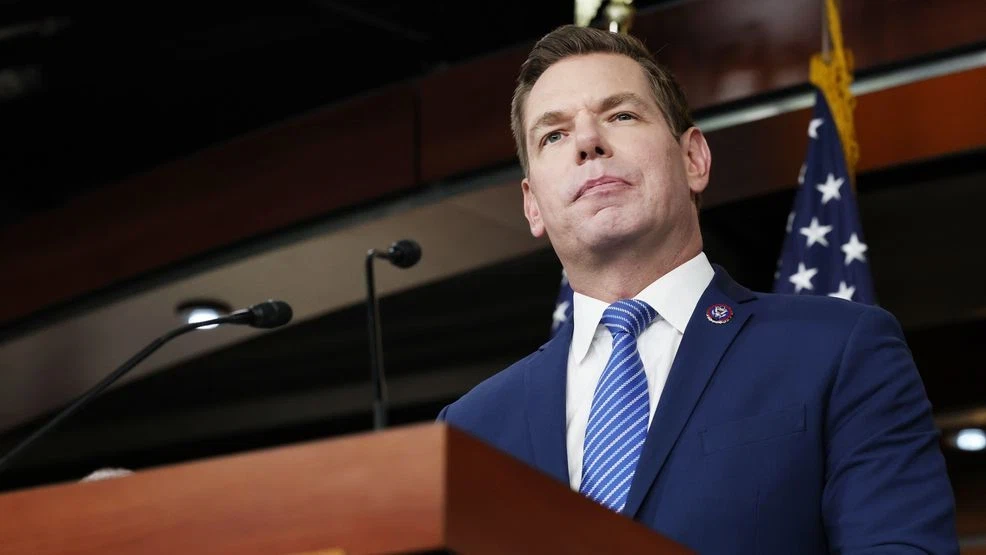
Pressure is intensifying inside the US Congress as lawmakers from both parties openly discuss whether Democratic Representative Eric Swalwell should be forced out of office. The push follows serious public allegations involving inappropriate conduct and sexual assault claims, which Swalwell has strongly denied.
According to Britain Chronicle analysis, the unfolding debate is no longer just about individual misconduct accusations but has become a wider test of how Congress handles accountability when political loyalty collides with reputational risk. The fact that expulsion talk is now bipartisan adds unusual weight to a process that is typically rare and politically explosive.
The controversy has also expanded beyond a single lawmaker. Some members are linking Swalwell’s case with separate allegations involving Republican Representative Tony Gonzales, signalling a growing willingness among some lawmakers to pursue a dual expulsion strategy that crosses party lines.
Calls to remove Eric Swalwell from Congress have escalated after multiple reports surfaced containing allegations of sexual misconduct and assault. The claims, published by major US media outlets, include accusations from several women, with one former staffer alleging a serious incident in 2024.
Swalwell has rejected the allegations outright, describing them as false, while also acknowledging what he called personal “mistakes in judgment” in a separate public statement. His legal team has also indicated potential legal action against at least one accuser.
The political fallout widened quickly. Republican Representative Anna Paulina Luna has introduced a move to expel Swalwell and has tied it to a parallel resolution targeting Republican Representative Tony Gonzales, who has faced separate scrutiny over personal conduct. This pairing has further intensified partisan tensions inside the chamber.
At the same time, several lawmakers have gone on record calling for Swalwell to resign before any formal expulsion vote is held, while others say Congress must consider disciplinary action regardless of party affiliation.
Expulsion from the US House of Representatives is extremely rare, requiring a high threshold of support and often signalling severe ethical or criminal concerns. The current situation places Congress in a politically sensitive position where due process, public trust, and partisan strategy intersect.
The allegations against Swalwell, though unproven in court, have already created reputational consequences that extend beyond his personal career. They also raise broader questions about how Congress responds when misconduct claims emerge against sitting members, especially during highly polarised political cycles.
If lawmakers move forward with expulsions, it could set a precedent for how similar cases are handled in the future. It may also deepen distrust between parties already divided over ethics enforcement and internal accountability.
What Analysts or Officials Are Saying
Several lawmakers have voiced strong opinions, with some Democrats and Republicans agreeing that resignation or removal should be considered if the allegations are substantiated or deemed credible by colleagues.
Some Democratic voices have emphasized that misconduct allegations should not be treated differently based on party affiliation, arguing that institutional integrity must come first. At least one senior Democrat has indicated openness to expulsion if it is applied consistently across similar cases involving Republican members.
Republican lawmakers supporting the move argue that the credibility of Congress is weakened when serious allegations are not met with decisive action. They frame expulsion as necessary to maintain public trust in the institution.
Meanwhile, others in Congress have taken a more cautious stance, stressing that legal processes and internal ethics procedures must be allowed to run their course before any final decision is made.\
Britain Chronicle Analysis
The escalation around Eric Swalwell reflects a deeper structural problem in US politics: disciplinary action inside Congress is increasingly shaped by political symmetry rather than purely ethical evaluation.
What makes the current moment distinctive is not only the severity of the allegations but the emerging strategy of pairing expulsion efforts across party lines. This approach suggests that disciplinary actions are being used not only as accountability mechanisms but also as tools of political balancing.
That creates a difficult dynamic. On one hand, lawmakers are under pressure to respond decisively to serious accusations. On the other hand, linking unrelated cases risks turning ethics enforcement into a transactional exercise, where one expulsion depends on another.
The broader risk is institutional fatigue. When Congress appears to act inconsistently or selectively, public confidence in internal oversight mechanisms weakens further. Even if expulsion efforts fail, the debate itself signals a growing willingness to challenge long-standing norms of internal restraint.
What Happens Next
The immediate future will depend on whether formal expulsion resolutions are brought to a floor vote and whether leadership allows them to proceed. Even if introduced, such motions face significant procedural and political hurdles.
Investigations into the allegations may also influence the pace of events, particularly if law enforcement or ethics committees advance parallel reviews. Any formal findings could significantly shift the balance of support either for or against disciplinary action.
At the same time, pressure on Swalwell to resign is likely to continue, especially if more lawmakers publicly align with calls for his departure. The parallel focus on Republican Representative Tony Gonzales adds another layer of complexity that could shape how leadership manages the issue.
UK Nuclear Deterrent: Vital for Britain’s National Defence

Ministers Urged to Share Mandelson Vetting Files Amid Disclosure Row

UK Considers Under-16 AI Chatbot Ban Amid Safety Push

MP Calls for National Biosecurity Strategy UK at Core of Security

Connor Naismith: Why Blue Labour is True Labour

NHS Legal Anomaly Costs Billions: Calls for Urgent Reform