
Viktor Orban election defeat Hungary reshapes EU politics
Viktor Orban election defeat Hungary marks a major political turning point as Hungary’s long-time prime minister is voted out after more than a decade in power. The result signals a clear shift in voter sentiment and a rejection of his nationalist and Russia-aligned governance. According to Britain Chronicle analysis… the outcome goes beyond domestic politics
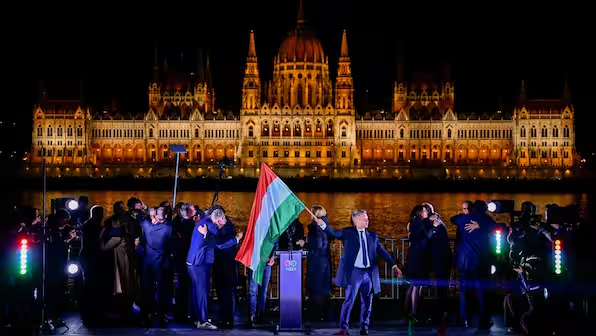
Viktor Orban election defeat Hungary marks a major political turning point as Hungary’s long-time prime minister is voted out after more than a decade in power. The result signals a clear shift in voter sentiment and a rejection of his nationalist and Russia-aligned governance.
According to Britain Chronicle analysis… the outcome goes beyond domestic politics and reflects a wider European recalibration. It weakens one of the most prominent illiberal governments inside the European Union and reshapes the balance of influence between Brussels, Moscow, and Washington.
The election comes at a sensitive moment for Europe, with ongoing tensions over Ukraine, internal EU divisions, and rising geopolitical pressure from both Russia and the United States. Hungary’s change in leadership could alter how the bloc responds to these challenges.
WHAT HAPPENED?
Viktor Orban election defeat Hungary was confirmed after official projections showed his ruling bloc losing its parliamentary dominance to Péter Magyar’s Tisza party. The opposition secured a strong majority, giving it the mandate to form the next government.
Orban’s defeat ends a political era that began in 2010, during which he reshaped Hungary’s constitutional and institutional framework. His government repeatedly clashed with EU institutions over rule-of-law standards, media freedom, and judicial independence.
European Commission President Ursula von der Leyen welcomed the result, stating that the incoming leadership has made clear commitments to a pro-European path. EU officials view the outcome as a potential reset in relations with Budapest after years of tension.
The vote also reflects domestic dissatisfaction with economic pressures, governance concerns, and Hungary’s increasingly isolated position within the European Union.
WHY THIS MATTERS
The Viktor Orban election defeat Hungary result carries significant implications for European unity and geopolitical strategy.
For years, Orban acted as a key internal blocker within the EU, often delaying or vetoing measures related to sanctions on Russia and financial aid to Ukraine. His departure is expected to reduce institutional friction inside the bloc.
However, the shift does not automatically resolve structural challenges. Hungary remains heavily dependent on Russian energy imports, limiting how quickly its foreign policy can change direction.
The result also weakens the alignment between European far-right movements and US political figures who had supported Orban’s leadership. His defeat signals that nationalist governance models still face electoral limits within the EU framework.
WHAT ANALYSTS OR OFFICIALS ARE SAYING
Officials in Brussels have cautiously welcomed the change, highlighting Hungary’s potential return to closer alignment with EU norms and decision-making processes.
Analysts argue that Viktor Orban election defeat Hungary reduces the likelihood of repeated vetoes on major EU policies, particularly those linked to Ukraine and sanctions on Russia. This could improve coherence in European foreign policy.
At the same time, experts warn that institutional reforms inside Hungary will not be immediate. Orban’s long tenure enabled deep changes in the judiciary, media environment, and electoral structures, which will take years to fully unwind.
Some observers also point to international ripple effects, noting that Orban’s close relationship with US President Donald Trump had made him a symbolic figure in global populist networks now facing political fragmentation.
BRITAIN CHRONICLE ANALYSIS
The Viktor Orban election defeat Hungary represents a strategic shift for Europe, but its impact should be understood as gradual rather than immediate.
Hungary is unlikely to undergo a rapid transformation from an illiberal governance model to a fully liberal democratic system. Instead, it is entering a phased transition where external policy alignment may change faster than internal institutional reform.
For the European Union, this development removes one of its most persistent internal disruptors. That could strengthen collective decision-making on Russia, Ukraine, and broader security policy.
However, Brussels now faces a different challenge: ensuring that political change translates into durable institutional stability rather than short-term policy adjustment. The risk of slow reform or partial rollback remains real.
Ultimately, the election reflects a broader European trend where voters are reassessing nationalist governance models amid economic pressure and geopolitical uncertainty.
WHAT HAPPENS NEXT
Following the Viktor Orban election defeat Hungary, Péter Magyar’s government is expected to prioritise rebuilding relations with the European Union and restoring institutional trust.
A key early test will be Hungary’s stance on EU financial support for Ukraine, including whether it lifts its veto on major funding packages. Any reversal would mark a significant shift in foreign policy direction.
Domestic reforms are expected to proceed more slowly, particularly in areas such as judicial independence and media regulation, where previous structural changes remain deeply embedded.
In the longer term, Hungary’s direction will depend on how effectively the new leadership balances EU integration with domestic economic constraints, especially energy dependence on Russia.
For Europe, the coming months will determine whether Hungary becomes a stabilising partner within the bloc or remains a cautious and incremental reformer.
UK Nuclear Deterrent: Vital for Britain’s National Defence

Ministers Urged to Share Mandelson Vetting Files Amid Disclosure Row

UK Considers Under-16 AI Chatbot Ban Amid Safety Push

MP Calls for National Biosecurity Strategy UK at Core of Security

Connor Naismith: Why Blue Labour is True Labour

NHS Legal Anomaly Costs Billions: Calls for Urgent Reform