EU state aid rules eased as energy prices surge
EU state aid rules energy crisis measures are being expanded as the European Commission moves to give member states greater flexibility in supporting businesses hit by rising fuel and fertilizer costs. The proposal comes amid sharp increases in global energy prices. According to Britain Chronicle analysis, the decision reflects growing urgency in Brussels to stabilise

EU state aid rules energy crisis measures are being expanded as the European Commission moves to give member states greater flexibility in supporting businesses hit by rising fuel and fertilizer costs. The proposal comes amid sharp increases in global energy prices.
According to Britain Chronicle analysis, the decision reflects growing urgency in Brussels to stabilise key sectors of the European economy as geopolitical tensions continue to disrupt global energy markets and push inflation higher.
The timing follows a renewed spike in oil prices linked to escalating military tensions involving Iran, adding further pressure on already strained European industries such as transport, agriculture, and manufacturing.
WHAT HAPPENED?
EU state aid rules energy crisis proposals were introduced by the European Commission as part of a wider emergency response package aimed at cushioning the economic impact of rising energy prices across the bloc.
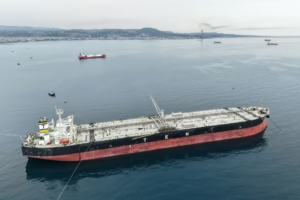
Oil prices surged above $100 a barrel after developments linked to a reported U.S. military blockade affecting shipping routes connected to Iran. The disruption has raised concerns about prolonged instability in global energy supply chains.
In response, Brussels proposed temporary changes to EU state aid regulations that would allow governments to increase direct financial support for industries most affected by higher fuel costs. These include agriculture, road transport, shipping, and other energy-intensive sectors.
Under the draft framework, member states could compensate companies for part of the increase in fuel and fertilizer prices compared with pre-crisis levels. The proposal also considers raising the cap on state support for electricity costs to above 50 percent for some industries.
Several EU governments, including Germany, Italy, Poland, and Hungary, have already introduced national measures such as tax relief, fuel caps, and targeted subsidies to ease pressure on businesses.
WHY THIS MATTERS
EU state aid rules energy crisis reforms are significant because they directly affect how far member states can go in protecting domestic industries during periods of economic shock.
By loosening restrictions on public subsidies, the European Commission is effectively acknowledging that existing market rules may be too rigid to handle prolonged energy volatility. This shift could reshape how Europe balances free competition with economic stability.
However, the move also raises concerns about uneven competition within the single market. Wealthier EU countries with larger budgets may be able to support their industries more aggressively than smaller economies, potentially widening economic disparities across the bloc.
At the same time, sectors such as agriculture and logistics remain highly exposed to fuel price fluctuations, making short-term intervention politically and economically unavoidable for many governments.
WHAT ANALYSTS OR OFFICIALS ARE SAYING
EU officials argue that the proposed changes are temporary and strictly tied to the ongoing energy disruption. They stress that the goal is to prevent long-term damage to critical industries while maintaining the integrity of the single market.
Analysts note that EU state aid rules energy crisis adjustments reflect a broader pattern of emergency policymaking in Brussels, where rules are increasingly adapted in response to external shocks.
Some economic observers caution that repeated relaxation of state aid limits could weaken long-term competition policy and lead to fragmented industrial support across Europe.
Others argue that targeted flexibility is necessary, especially given the severity of energy price spikes and the exposure of key sectors like transport and agriculture.
BRITAIN CHRONICLE ANALYSIS
The expansion of EU state aid rules energy crisis flexibility highlights a growing tension at the heart of the European project: the balance between market discipline and crisis-driven intervention.
On one hand, the EU continues to defend the principle of fair competition across its single market. On the other, repeated global shocks—from pandemic recovery pressures to geopolitical energy disruptions—are forcing policymakers to loosen fiscal constraints.
This shift may offer short-term relief to businesses but risks creating long-term divergence between member states with different fiscal capacities. Larger economies are better positioned to deploy subsidies at scale, potentially distorting competition within the bloc.
The broader implication is that Europe is entering a more interventionist economic phase, where emergency tools are becoming structural features of policy rather than temporary exceptions.
WHAT HAPPENS NEXT
EU state aid rules energy crisis proposals will now undergo consultation with member states, which are expected to submit feedback before a final version is adopted later this month.
If approved, the temporary framework will allow governments to expand subsidies for fuel and energy costs across key industries, with implementation likely varying significantly between member states.
The European Commission is expected to maintain that all measures remain time-limited and tied directly to energy market disruptions.
In the coming months, attention will focus on whether these emergency allowances stabilize affected sectors or deepen economic imbalances within the EU’s internal market.
Sustainable Empathy Leadership: Preventing Manager Burnout

Global Business Districts Rebound as Economic Hubs: EY Report

AI Floods Creative Market: The Need for Industry Governance
IMF warns Europe on targeted war energy support
Ireland’s Data Center Boom Strains Power and Growth Model
Iran Crisis Pushes EU Economy Off Summit Agenda