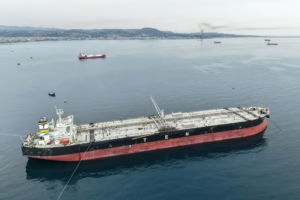
Oil Prices Fall as Trump Agrees to Iran Ceasefire Pause
Global financial markets surged after oil prices plunged sharply following news that the United States and Iran had agreed to a two-week ceasefire, easing fears over supply disruptions in the Strait of Hormuz. According to Britain Chronicle analysis, the sudden reversal reflects how quickly geopolitical risk premiums can unwind in energy markets when even temporary

Global financial markets surged after oil prices plunged sharply following news that the United States and Iran had agreed to a two-week ceasefire, easing fears over supply disruptions in the Strait of Hormuz.
According to Britain Chronicle analysis, the sudden reversal reflects how quickly geopolitical risk premiums can unwind in energy markets when even temporary stability is restored.
The development comes after weeks of volatility that had pushed oil higher, shaken equities, and raised concerns about inflation and global growth.
What Happened?
US President Donald Trump announced a temporary suspension of bombing and attacks on Iran, confirming a two-week ceasefire framework while broader peace discussions continue.
The announcement triggered an immediate market reaction, with US crude futures falling around 16.5% to approximately $94 a barrel as supply disruption fears eased.
The conflict had escalated after military actions involving Iran and regional tensions that disrupted shipping through the Strait of Hormuz, a critical route for global energy transport.
During the earlier escalation, Tehran had effectively restricted passage through the waterway, raising fears that nearly one-fifth of global oil supply could be affected.
Following the ceasefire news, equity markets surged, with S&P 500 futures rising more than 2%, while bonds also rallied as investors shifted away from safe-haven positions.
Currency markets reflected the shift in sentiment, with the US dollar weakening as risk appetite returned, while the euro, Australian dollar, and cryptocurrencies all posted gains.
Why This Matters
The Strait of Hormuz remains one of the most strategically important energy corridors in the world, and even temporary disruptions can significantly impact global prices and inflation expectations.
The recent spike in oil prices had already begun feeding into broader inflation concerns, affecting transport costs, consumer prices, and central bank outlooks.
The sudden reversal highlights how dependent global markets remain on geopolitical stability in key shipping regions, particularly for energy security.
It also demonstrates the sensitivity of financial systems to policy announcements, where even short-term diplomatic shifts can trigger large-scale asset repricing across commodities, equities, and currencies.
What Analysts or Officials Are Saying
Market analysts said the rally reflects relief that a worst-case energy disruption scenario has been temporarily avoided.
One strategist noted that investors had been positioning for continued escalation, and the ceasefire created an immediate “risk-off unwind” across commodity markets.
Financial observers also pointed out that oil markets had already been pricing in sustained supply risks, making them especially vulnerable to sudden geopolitical de-escalation.
At the same time, uncertainty remains, as the agreement is temporary and dependent on continued adherence by both sides, leaving markets exposed to renewed volatility.
Britain Chronicle Analysis
This episode underscores the fragile balance between geopolitics and global financial stability. Energy markets, in particular, act as a rapid transmission channel for political risk, often amplifying short-term developments into global economic shocks.
The sharp fall in oil prices shows how quickly risk premiums can collapse when supply fears ease, even if only temporarily. However, it also highlights how unstable that repricing can be when underlying tensions remain unresolved.
For policymakers and investors, the key issue is not just the ceasefire itself, but the lack of certainty about its durability. Markets are reacting to a pause, not a resolution.
This creates a pattern of sharp swings in both directions, where prices surge on escalation and collapse on de-escalation, increasing volatility across all asset classes tied to energy expectations.
What Happens Next
Markets will now focus on whether the ceasefire holds beyond the initial two-week period and whether formal negotiations lead to a longer-term agreement.
Oil traders will closely monitor shipping activity through the Strait of Hormuz for signs of renewed disruption or stabilization.
Equity and currency markets are likely to remain highly sensitive to any new developments in the conflict, with volatility expected to persist in the short term.
If tensions re-escalate, energy prices could quickly reverse recent losses, while a sustained peace agreement could extend the current rally across global markets.
Sustainable Empathy Leadership: Preventing Manager Burnout

Global Business Districts Rebound as Economic Hubs: EY Report

AI Floods Creative Market: The Need for Industry Governance

IMF warns Europe on targeted war energy support

Ireland’s Data Center Boom Strains Power and Growth Model
Iran Crisis Pushes EU Economy Off Summit Agenda