IMF Warns Iran War Will Scar Global Economy Long-Term
The head of the International Monetary Fund has warned that the ongoing Iran conflict will leave lasting damage on the global economy, even if a durable peace agreement is eventually reached. According to Britain Chronicle analysis, the warning signals growing concern among global financial institutions that the economic fallout from the war is becoming structural
The head of the International Monetary Fund has warned that the ongoing Iran conflict will leave lasting damage on the global economy, even if a durable peace agreement is eventually reached.
According to Britain Chronicle analysis, the warning signals growing concern among global financial institutions that the economic fallout from the war is becoming structural rather than temporary.
The remarks come as volatility in energy markets, shipping routes, and investor confidence continues to ripple through the global financial system.
What Happened?
Kristalina Georgieva said the war in Iran has already created “scarring effects” that will reduce global growth forecasts, even under optimistic peace scenarios.
She indicated that prior expectations for stronger global growth in 2026 would have likely been upgraded if the conflict had not erupted, but instead have now been revised downward.
Georgieva warned that there would be no return to pre-war economic conditions, even in a best-case outcome, highlighting long-term disruption to trade, investment, and energy flows.
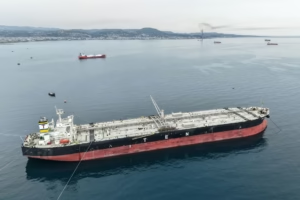
The conflict has disrupted shipping and energy transit through the Strait of Hormuz, a critical route for global oil supplies.
Oil prices have remained volatile as markets react to uncertainty over supply chains, damaged infrastructure, and the uncertain future of regional trade routes.
Why This Matters
The IMF’s warning suggests the economic consequences of the conflict are no longer viewed as short-term shocks, but as lasting structural damage to global output.
Energy-importing countries, developing economies, and small island states are expected to be among the hardest hit due to higher costs and weaker financial buffers.
Disruptions to shipping lanes and energy infrastructure are also feeding into inflationary pressure, complicating monetary policy decisions worldwide.
The broader concern is that repeated supply shocks may reduce long-term productivity growth and increase global inequality between regions.
What Analysts or Officials Are Saying
IMF officials stressed that every scenario they have modelled shows a permanent reduction in living standards, even if a peace agreement is achieved.
They warned against protectionist responses such as export restrictions or price controls, arguing that such measures could worsen global instability.
Central banks have been urged to remain cautious, balancing inflation risks with slowing growth, while governments are encouraged to target support only to the most vulnerable groups.
Andrew Bailey also described the situation as a “very big shock,” noting increased market volatility and uncertainty across global financial systems.
Britain Chronicle Analysis
The IMF’s assessment marks a significant shift in how global institutions are framing geopolitical risk: not as cyclical disruption, but as permanent economic loss.
Unlike previous crises where recovery was expected to restore lost output, this conflict is being treated as one that permanently lowers the global growth trajectory.
The key driver is energy system fragility, where disruption to a single chokepoint can cascade into inflation, reduced trade, and weakened investment confidence worldwide.
This creates a policy dilemma: governments must respond to immediate economic pain while accepting that pre-crisis growth levels may no longer be achievable.
For global markets, the implication is that volatility is not temporary noise but a feature of a more unstable economic era.
What Happens Next
The IMF is expected to release updated global growth forecasts in its upcoming World Economic Outlook, reflecting revised assumptions about energy supply and geopolitical risk.
Markets will continue to monitor oil prices, shipping stability, and diplomatic developments for signs of either escalation or stabilization.
Policy responses from major economies will likely focus on inflation control and energy security, with increasing emphasis on supply diversification.
Even if a peace agreement is reached, economists expect prolonged adjustment as economies absorb the long-term effects of disrupted trade and investment patterns.
Sustainable Empathy Leadership: Preventing Manager Burnout

Global Business Districts Rebound as Economic Hubs: EY Report

AI Floods Creative Market: The Need for Industry Governance
IMF warns Europe on targeted war energy support
Ireland’s Data Center Boom Strains Power and Growth Model
Iran Crisis Pushes EU Economy Off Summit Agenda